

As state continues to lose thousands of acres of farmland each year, Farm Credit is proud to help the Trust expand its efforts which now protects more than 20,000 acres of prime irrigated ag land
There’s a simple but compelling reason why the California Farmland Trust has been working to preserve prime farmland in the state’s Central Valley for 23 years.
“Without agriculture, we don’t eat. Without farmland, we don’t have agriculture,” said Farmland Trust board member Mike Machado, who has placed three San Joaquin County properties into the Trust over the years.
That’s why the Trust continues to protect prime irrigated farmland by working with landowners to sell or donate their development rights to the Trust, ensuring that farms can stay in production for generations to come while permanently protecting the land from development.
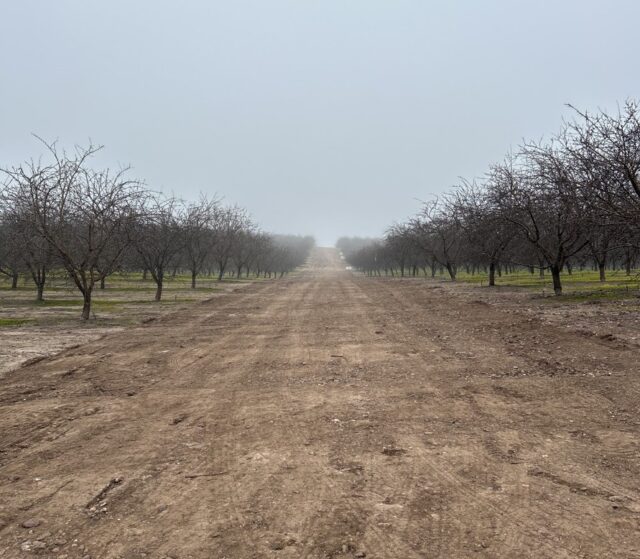
The Trust recently celebrated its 90th conservation project — an orchard in Stanislaus County — and has now secured 20,068 acres of farmland from Elk Grove to Fresno that will remain farms forever.
Charlotte Mitchell, the Trust’s executive director, said protection is becoming more urgent.
“It’s easy in the most prolific agricultural state in the nation to presume that what we have now will always be, but it’s a fool’s errand to presume that we’re going to continue to maintain the same amount of ag land actively used to produce food, fiber, flora and fauna for the world,” Mitchell said. “Our state loses approximately 50,000 acres of farmland to development every year, and anecdotally, we know that number is growing.”
Jacob DeBoer, Director of Marketing for American AgCredit said preserving California’s prime farmland from development is important for many reasons.
“Our state’s farmland, particularly in the Central Valley, is among the best in the world, so growing food to feed the nation and the world here is the highest and best use for these soils,” DeBoer said. “And we can’t forget that agriculture is a cornerstone of California’s economy, generating more than $50 billion a year and employing over 400,000 people. Farm Credit is proud to support the great work the Farmland Trust is doing to keep farming here forever.”
Kevin Ralph, California President for AgWest Farm Credit, noted that conservation easements can be both practical and personal.
“Families gain peace of mind that comes with knowing their family farm will remain a farm forever,” Ralph said. “Easements can help keep the farm intact through inheritances or other ownership changes and often provide an infusion of cash for operations or debt reduction. In many cases, it’s a real win-win.”
Farm Credit associations supporting California Farmland Trust are AgWest Farm Credit, American AgCredit and CoBank. These organizations are part of the nationwide Farm Credit System – the largest provider of credit to U.S. agriculture.
The Trust is California’s only land trust dedicated solely to conserving irrigated farmland. Today, it’s targeting key areas – west and south of Lodi, the Manteca-Lathrop area, north of Modesto and pockets in Merced County – with the goal of linking working farms into greenbelts to protect agricultural landscapes at a larger scale.
Its most recent acquisition is the 593-acre Three Bars Ranch near Oakdale. Once a renowned horse ranch, in recent years it’s been converted to almond and walnut production, with a small olive grove and grazing land. The property is highly visible from Highway 108/120, making the protection meaningful for not only ag but also for the scenic rural landscape of eastern Stanislaus County.
The property also represents an important example of conservation in a landscape facing development pressure. Three Bars Ranch is near the planned North County Corridor, a major transportation project intended to realign Highway 108 around Modesto, Riverbank and Oakdale. During the conservation process, the Trust worked with the landowner and project agencies to identify and exclude areas that could potentially be affected by the future transportation project, allowing the conservation easement to focus on the agricultural land intended for long-term protection.
“This project reflects the collaborative nature of farmland conservation,” Mitchell said. “Working with landowners, public agencies and funding partners allows us to find solutions that protect agricultural land while recognizing the realities of a changing region. The result is a stronger future for both farming and the communities that depend on it.”
Besides working to prevent a hodgepodge of farms interspersed with urbanized parcels, Mitchell said the Trust is prioritizing working agricultural greenbelts that will continue to have access to water as the state limits groundwater pumping in many areas.
The Trust is funded in part by grants and donations from individuals and organizations like Farm Credit along with mitigation fees from developers, but the largest source of revenue are grants from the State and USDA farmland protection programs. She said additional funding would be welcome, but because the decision to prohibit future non-agricultural development can’t be entered into lightly, the Farmland Trust will continue to move slowly and methodically to make sure a family is convinced that establishing a permanent easement is the right thing for them.
“This is a process that needs to take into consideration a lot of important factors, starting with the family and how the family will be affected, where you’re at generationally, who is currently running the farming operation, where elders sit in that decision-making process and certainly where the next generation fits into things,” Mitchell said.
“When we say forever, we really do mean forever. So, we have multiple points in our process for families to stop, pause, reflect, and ask questions.”
###
About Farm Credit:
AgWest Farm Credit, American AgCredit and CoBank are cooperatively owned lending institutions providing agriculture and rural communities with a dependable source of credit. For more than 100 years, the Farm Credit System has specialized in financing farmers, ranchers, farmer-owned cooperatives, rural utilities and agribusinesses. Farm Credit offers a broad range of loan products and financial services, including long-term real estate loans, operating lines of credit, equipment and facility loans, cash management and appraisal and leasing services…everything a “growing” business needs. For more information, visit www.farmcreditalliance.com
About the California Farmland Trust:
California Farmland Trust is a California nonprofit 501(c)(3). Our mission is to help farmers protect the best farmland in the world. To date, we have protected 20,068 acres of farmland on 90 properties in the Central Valley. To learn more, visit us at www.cafarmtrust.org.